
Grossglockner is a peak in Austria that tops out at 3,798 meters above sea level (or 12,461 ft). It’s the tallest mountain in Austria, and the 7th tallest in Europe. It was also the site of a tragic accident in January of 2025 where 33 year old Kerstin Gurtner lost her life — frozen to death — due to a series of unfortunate decisions. Now, her boyfriend, who was part of the 2-person expedition, is being charged with manslaughter by gross negligence.
As a woman who enjoys doing extreme sports in the mountains, I must ask: How could things go so wrong? Why is one person is dead and the other is facing 3 years of prison time? And what can I learn from this, so that I don’t meet a similar fate?
Let’s look at some of the facts and a timeline of events:
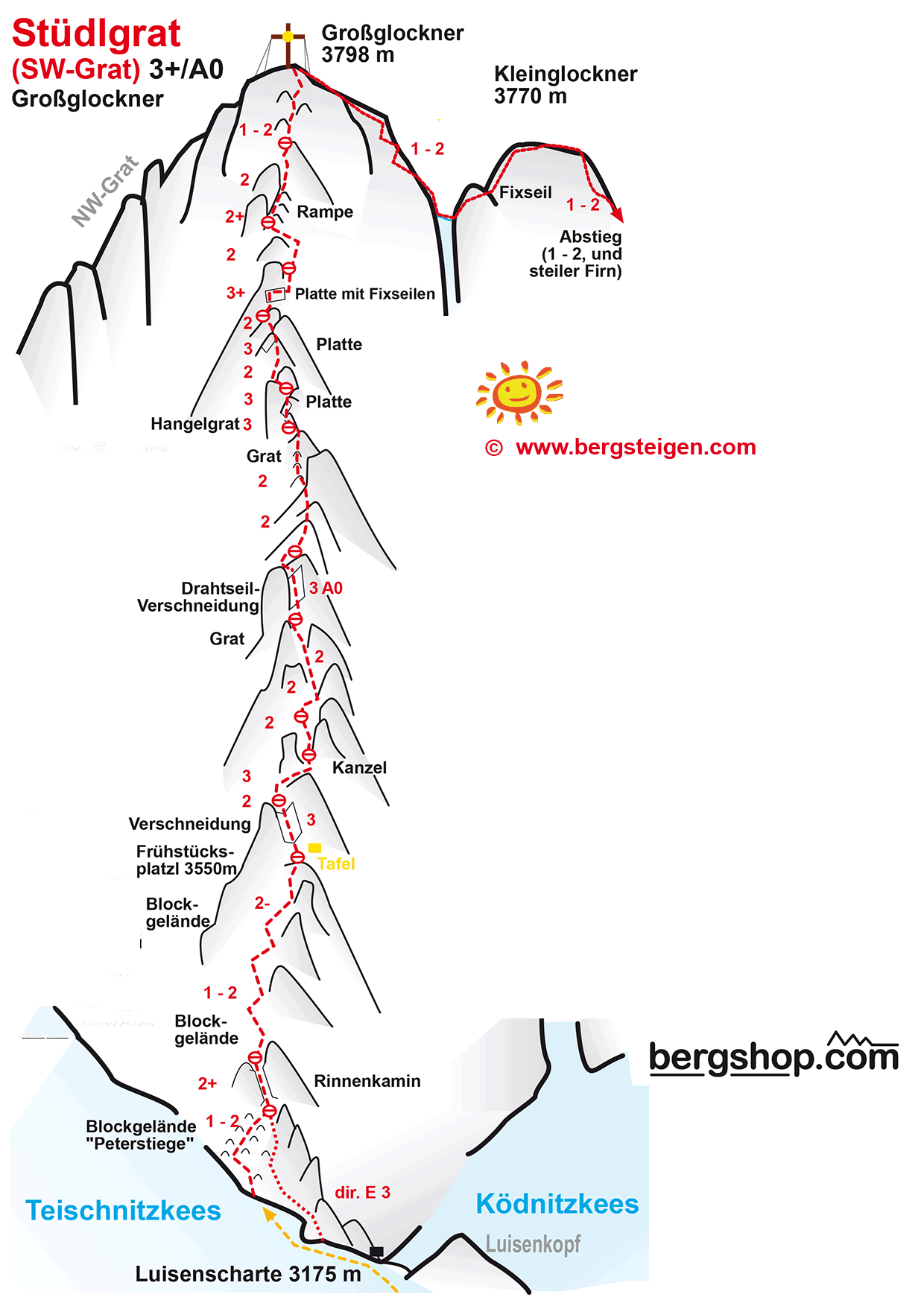
Goal: Reach the summit 3,798m taking the Stüdlgrat Ridge
Difficulty: UIAA III-IV in normal conditions (which means it is a full day route in exposed, remote conditions on a good weather day).
Topos:See the topos here from bergsteigen.com
Equipment: Gurtner had a splitboard and snowboard boots, but other equipment is unknown.
Weather Conditions: According to reports the weather was normal during the day with slight winds and below freezing temperatures, turning worse in the evening with 80km/h wind gusts, -20°C /-4°F windchill, and stormy conditions.
Timeline:
- 6:45 – Gurtner and her partner, Thomas Plamberger, begin their climb
- 13:30 – Plamberger and Gurtner arrive at Frühstücksplatzerl (“Breakfast Spot”) which is considered a common rest/turn around spot on the route
- 20:50 – Weather had significantly worsened
- 22:30 – Rescuers in the valley take photos of their headlamps that could be seen ascending to the summit.
- 22:30-22:50 – Rescuers try to contact Plamberger by phone and also send a helicopter to provide assistance but are not flagged down by the couple.
- 00:25 – Plamberger returns the calls {contents of the conversation are unclear}
- 2:00 – Plamberger descends the mountain alone, leaving Gurtner around 50m from the summit. She was apparently exhausted and disoriented and he had gone for help.
- 3:30 – Plamberger makes another call to rescue services
- 7:00 – Helicopter rescue is aborted due to strong winds
- 10:00 – Gurtner’s lifeless body is found and recovered by mountain rescue teams, cause of death determined to be hypothermia.
To read more about this case and the timeline in depth, I highly suggest Owen Clarke’s article on Climbing.com. He goes further into the investigation, and even speaks with mountain guides for their opinions on lessons learned.
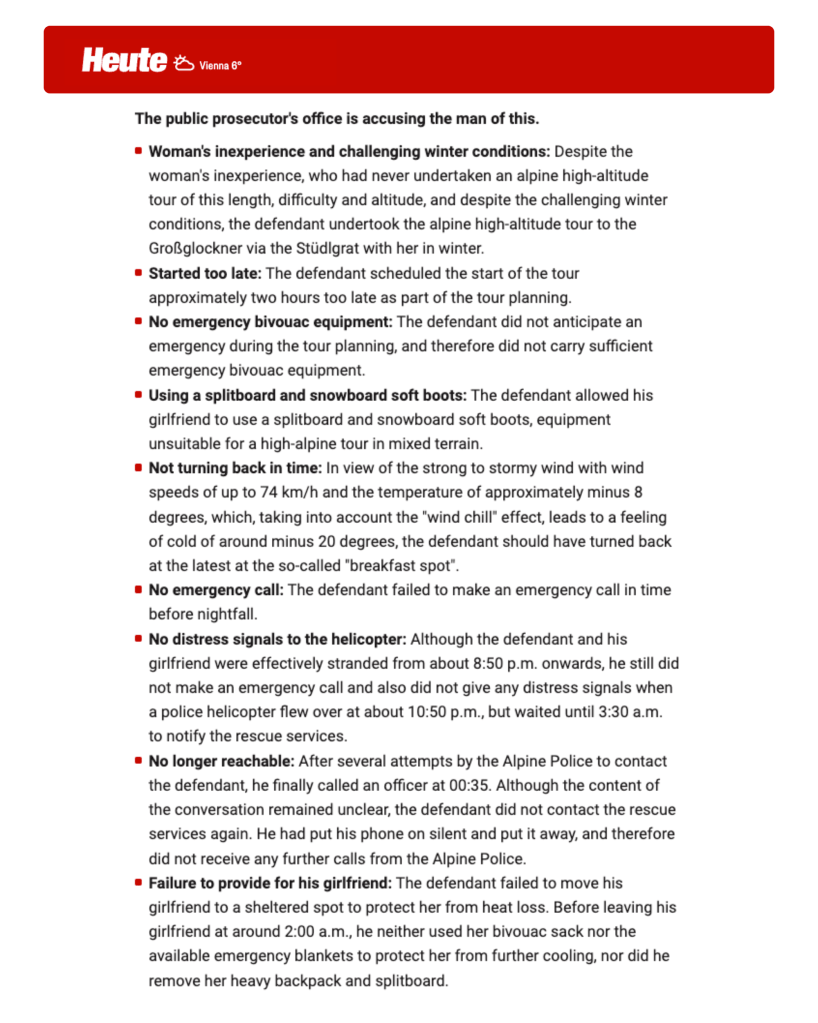
According to Heute, the allegations against Plamberger are as follows:
So what can we learn from a tragedy like this? My biggest take away here as a woman and beginner in these types of sports is that we must, must, always advocate for ourselves and our safety in the mountains (or anywhere). Other people will not protect you. Either because they do not know that you need help, overestimate your ability, or because they do not care or take you seriously. Worst case scenario is that they want to actively or passively do you harm.
Oh goodness me, here comes the feminism.
No.
This is a lesson for anyone in the mountains who might be going with someone who has an influence over them. Whether that be a romantic partner, or even just a friend. Advocating for yourself is a key component of keeping your bodily autonomy, integrity, and security in risky situations. Man or woman.
Start with self-awareness. Know your own limits and don’t let anyone talk you into doing things you are not ready for. I have been snowboarding for 20+ years and I have seen people take their newbie friends on black slopes for no good reason other than… ego probably. This happened to me when I was learning to ski. Literally on my first day, a friend of mine took me up a red slope. I basically rolled down the hill, trying to avoid being a speed bump for other more experienced skiers.
This results in injury or even just a disgust or fear for the sport. This is a hard thing to do, especially if you trust the other person not to put you in a dangerous situation. But the thing is, sometimes the other person doesn’t think they are putting you in a dangerous situation. For them, it’s a piece of cake. It’s easy. This is the pesky “Curse of Knowledge” bias at work. Someone with this curse will not understand the danger they are putting you in.
Learn when to say “Enough”. Knowing when to turn back on a hike, or when to say stop and mean it, will save your ass almost every time. But, like I said before, this is hard. People do not like to be told no. Alternatively, you yourself might not like to cut a hike short because a storm “might” be coming or your GPS stopped working. “Figuring it out” is a great way to YOLO your way into a body bag.
Be prepared for the unpredictable and improbable. Do you have plans to go to the mountains for an activity? Great. Do your own research on what you need to be safe. What equipment do you need, what knots you need to know, when should you leave, what do you need to be aware of. Then you can always cross check that information with what your guide or partner is telling you. You’ll be surprised how many people just go willy-nilly into the wilderness with no understanding of what could go wrong. Which brings me to…
Take serious things seriously. Safety is serious. The mountains will eat you alive. The weather doesn’t care about your feelings. Don’t let anyone downplay the seriousness of dangerous situations in a way that will bring your guard down. Mistakes multiply and there is a point where enough is enough and its time to stop the activity.
 Kylbasa
Leave a comment